Walking Utrecht's Canal Ring: How Long It Really Takes
 Walking Utrecht's Canal Ring: How Long It Really Takes
A practical guide to circling the Oudegracht and Nieuwegracht on foot, including where the wharves slow you down and which stretch to skip.
The full loop, measured honestly
The complete circuit of Utrecht's canal ring is roughly 6 kilometres if you follow the water rather than the streets. Walking steadily without stopping, that is about 75 to 90 minutes. But almost nobody walks it steadily. The Oudegracht between the Domplein area and the Ledig Erf is lined with wharf-level terraces and cellars reached by stairs, and each descent costs you a few minutes and often a coffee. Budget three hours and you will enjoy it far more than the two you might plan from a map.
Start and finish at Utrecht Centraal, which puts you five minutes from the beginning of the Oudegracht near Hoog Catharijne. The station is also the tram hub for lines 20, 21 and 22 if you decide to shorten the return leg. A sensible order is south along the Oudegracht to Ledig Erf, then north-west along the Nieuwegracht to the Pausdam area and back east through the museum quarter. This keeps the busiest tourist stretch early and ends near the station.
Where the walking gets slow
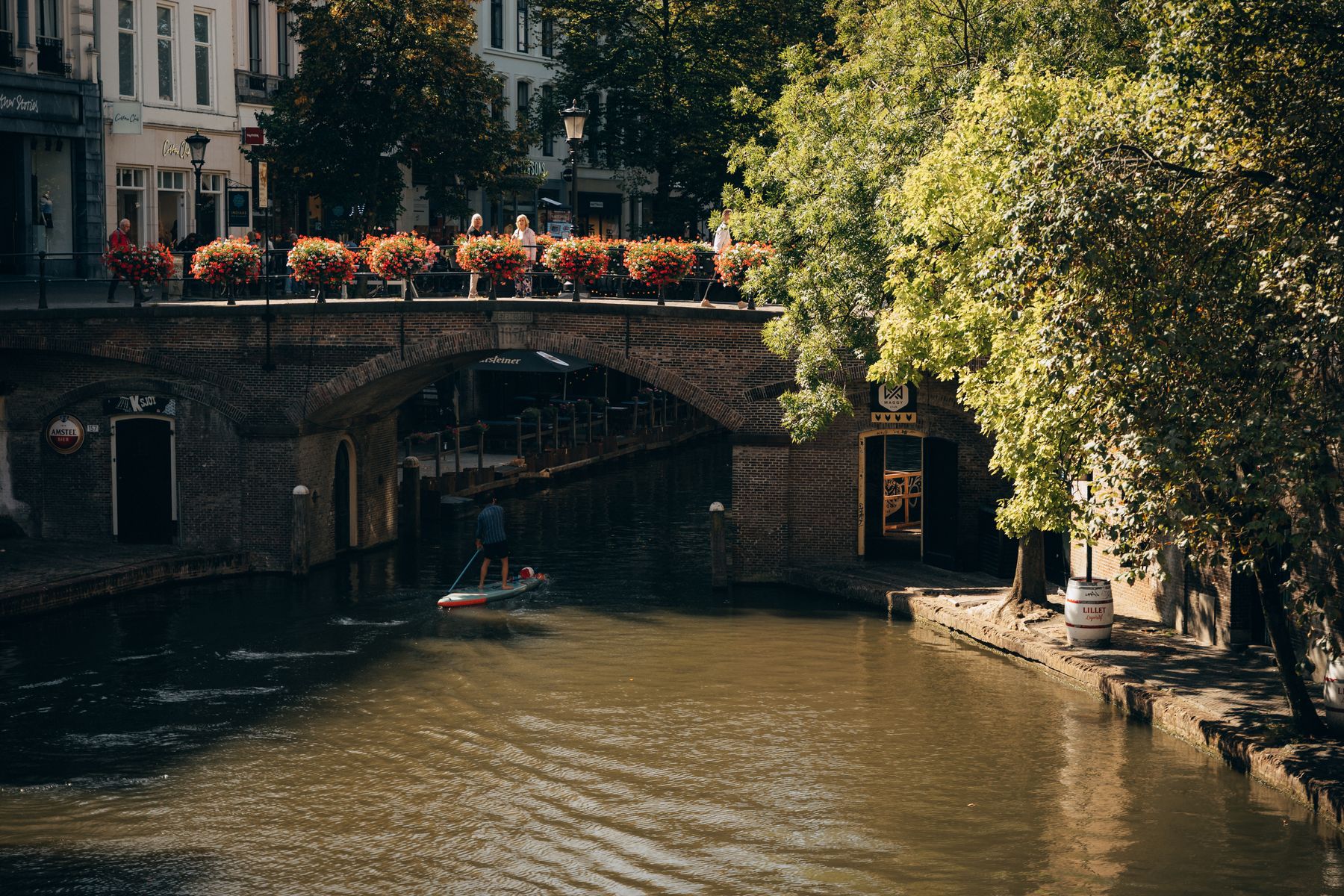
The wharves are the reason. Utrecht's unique two-level canal system means the Oudegracht has a street-level quay above and a lower wharf directly on the water, connected by stone staircases every 50 to 100 metres. Descending, wandering under the arched cellars and climbing again adds perhaps 15 minutes to a kilometre of walking. The stretch between the Bakkerbrug and the Gaardbrug is the densest, and on a Saturday afternoon in July or August it can be shoulder-to-shoulder between 12:00 and 16:00.
If you want speed, walk the upper quay and look down rather than descending. The Nieuwegracht, one kilometre west, has almost none of this traffic. It is quieter, narrower, and lined with 17th-century houses and leaning trees. I would walk the Oudegracht once for the experience and use the Nieuwegracht for the return leg. Best months are April to June and September to early October; July and August are warm but crowded, and November to February is cold, frequently wet and dark by 17:00.
Shortening the route without missing much
Not everyone wants six kilometres. A satisfying half-loop is Centraal to Ledig Erf along the Oudegracht, about 2.5 kilometres or 40 minutes with stops, then a 10-minute walk west along the singel to the Nieuwegracht and back north to the station. That covers the two canals that matter and takes about 90 minutes total. The eastern singel between the Maliebaan and the Wilhelminapark is pleasant but residential and adds distance without adding much for a first visit.
For a shorter version again, concentrate on the Oudegracht between the Vismarkt and the Ledig Erf, roughly one kilometre. That includes the Dom tower views, the busiest terrace section and the Museum Catharijneconvent at the northern end. Allow an hour with a stop. Skip the stretch north of the Vismarkt towards the Weerdsluis unless you are heading to the Molen Rijn en Zon windmill, which is worth 20 minutes on its own but sits slightly off the main loop.
Practicalities for the day
Utrecht's canals are not a single loop in the way Amsterdam's are; the Oudegracht runs roughly north-south through the centre and the singel forms the outer ring. Walking the entire singel is about 5 kilometres and takes 70 minutes without stops, but it passes behind the station and through quieter edges that many visitors find less rewarding. Combining half the Oudegracht with half the Nieuwegracht, as above, gives the best ratio of interest to effort.
Wear shoes that grip. The wharf stairs are worn stone and can be slick after rain, and some lower wharves flood slightly in winter. Public toilets are limited; the Vismarkt area and the library at Oudegracht 167 have options, and cafes generally expect a purchase. If you are staying overnight, hotels around the Nieuwegracht and the museum quarter put you within a few minutes of the quieter canal and 10 to 15 minutes' walk from Centraal, which is the arrangement I would book for a two-night stay.
Before you book
The questions people ask about Utrecht, answered with this month’s numbers.
The full Oudegracht-and-singel circuit is about 6 kilometres, or 75 to 90 minutes without stopping. With wharf descents and a coffee, allow three hours. A half-loop using the Oudegracht and Nieuwegracht takes about 90 minutes.
Yes, the city is flat and the streets are paved. The only effort comes from the stone staircases down to the lower wharves, which are steep and worn. If stairs are difficult, stay on the upper quay; you still see everything from above.
April to June and September to early October offer mild weather and manageable crowds. July and August are warm but the Oudegracht wharves are very busy between midday and late afternoon. December and January are quiet but often wet and dark by 17:00.
Exit towards Hoog Catharijne and you reach the Oudegracht in about five minutes. Head south first towards Ledig Erf, then return via the Nieuwegracht. This puts the busiest section early and ends close to the station for the train home.
Wharf-level cafes and restaurants line the Oudegracht, especially near the Vismarkt and Ledig Erf. Public toilets are scarce; the library at Oudegracht 167 is useful, and cafes generally expect you to buy something. Carry water in summer.
Utrecht's is smaller and centred on one main canal rather than a concentric ring. The defining feature is the two-level wharf system, which Amsterdam lacks. Utrecht is quieter, less crowded outside high summer, and the whole loop is comfortably walkable in an afternoon.
Yes. The Dom tower sits a few minutes east of the Oudegracht near Domplein. Climbing it takes about an hour including the guided tour, so add that to your walking time. Book ahead in summer, as slots fill.
The Nieuwegracht and museum quarter are quiet and central, within 10 to 15 minutes' walk of Centraal. The streets around Ledig Erf suit evening dining. I would choose the Nieuwegracht side for a two-night stay: close to everything, but away from the late-night noise of the Oudegracht terraces.